ValeriaAndradeProaño/Sujeta a Cambios
embodiments-indisciplines

EL GOCE DE-MENTE DE CUERPO
This book is an invitation to re-create and expand the stage experience, recognizing that play is the door to our creativity. It gathers ideas and methodologies of creation and turns them into playful experiences that awaken the extraordinary in the everyday.
Its nature changes with the way it is inhabited: played in company, it becomes a territory of encounter where whoever allows themselves to enjoy the actions wins. Played alone, it becomes an intimate oracle that invites us to notice the small wonders of daily life and awakens marvel in the familiar.
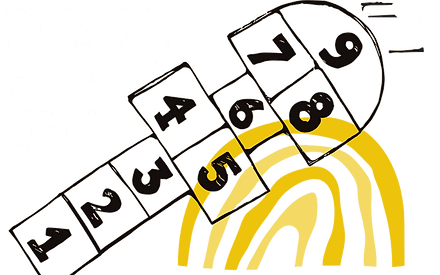
It is a book that unfolds into a game board. As it opens, a concentric stage appears, moving from intimate space to the close bonds that make community and reaching the cultural context, like waves spreading from the center of the self toward public space. It can be traveled from the outside in and back again; it does not matter where it begins or where it ends.
It includes several elements: a cuca (paper doll) with three costumes, two dice and 21 cards that prompt us to create experiences and uncover future memories in a territory where childhood, youth, maturity and old age speak to each other without hierarchies. The game dissolves the borders between age, memory and reality, creating a moment of personal and shared utopia.
It is a composition mechanism that goes beyond the stage and becomes a tool for reflection, where each interaction feeds a living archive. It is a ritual field where bodies find their secret language and each person becomes co-author of a memory that is constantly reinvented.
Note: the online game on this page is in Spanish. In oracle mode, hover over a random card and carry out the action it indicates.
ACKNOWLEDGEMENTS
This project is the result of the joint effort of a collective that brings these imaginings into matter from many places.
To my family, the unconditional support that lets dreams take shape. To my friends, accomplices in this creative adventure, for the conversations that feed ideas, for the shoulder-to-shoulder support and the shared joy.
To each person who in some way was part of this process: those who lent their time, talent, energy and trust so that this work could come to life.
Thank you for believing in the power of the collective, for understanding that creating is always a communal act, and for making it possible for fantasies to become tangible realities.
CREDITS
Conceptualization:
Valeria Andrade Proaño
Isabel González Ramírez
Editorial structure:
Edward Cooper
Valeria Andrade Proaño
Performative games:
Valeria Andrade Proaño
Design of the Cuca and woodcuts:
Rosa Elena Grijalva
Design and layout:
Susana Oviedo - ZIETTE
Illustration:
Susana Oviedo
Edward Cooper
This book finished printing in September 2025 in Quito, sponsored by the Municipality of Quito through the Secretariat of Culture.
BODY IN COEXISTENCE
I return to the body, to knowing the body, which unfolds threads of energy toward the inner wisdom woven in silence. In its materiality are imprinted ancient and multitudinous knowledges that emanate with each breath, emerge in movement and reveal themselves in touch. Thus the mind, as an extension of the body, reveals its passage toward the consciousness that manifests in every cell.
The body extends as a repertoire of sensations, a territory of memories where each gesture inscribes the trace of every everyday action, drawing an intimate cartography formed in the folds, in the masses, in the dermis, in the bones. From this materiality, it claims feeling as a situated form of knowledge. So I return to the body, in a state of presence, letting myself be permeated by its intelligence, which recognizes in each being its own existence.
A mediator between inside and outside, the body holds personal history, but also collective history. Thinking the individual body in relation to the community body means reflecting on a shared field that must recover its sovereignty by reweaving affective bonds and composing events for common acuerpamiento (bodies gathering in solidarity). This reflection becomes a call to suture, rebuild, mend and heal affections, to practice a radical politics of care and the common good, embodying a poetics of giving and receiving that protects the life and dignity of every other.


LA JUARASJUASJUAS COLECTIVA
Nothing that exists here is made by my will alone. Everything is the product of shared action, of joint labor, of construction through dialogue and consensus, to generate a force that embraces shared feeling. Such creation is collective and is in constant movement of emotion, sensation and thought, shaping our longings. These desires are not a sum of individual wills but the expression of a transindividual desire born from the conjunction of ideas in a momentary letting go of personal limits, where wills intertwine.
In the course of that exchange, laughter always appears, an effervescent burst that sets rhythms of communion. That is what I call the carnivalization of artistic production. I take up this carnivalesque sense in the work, as a way of challenging our reality through humor, parody, irony. Humor appears as presence of mind that transforms the environment, as a dynamic of inverted reality born of our constant carnival, where order is placed neither right side up nor upside down.
The instinct to play is reawakened as a call to the childhood of desires, aspirations and intuitions; with no use other than giving momentum to the community of meaning in the moment of living together. The politics is one of collaboration and exchange that allows us not only to subsist but to produce and create from interpersonal processes where ideas are caught and mixed. This mechanics of giving and appropriating provokes other associations, new forms that hybridize languages and give formats a breadth where the personal, the social and the political cross.
WHAT IS A CUCA?
Cucas are paper dolls: paper figures with interchangeable dresses that inhabit girlhood. But here, paper becomes action, the passive doll turns into an active alter ego, and the dresses become temporal portals that prompt real people.
Cucas keep the magic of instant transformation but expand it from paper to flesh, from the private to the public, from childhood play to liberating performance. In dressing the cuca, we recognize in her an unexplored aspect of ourselves. It is the moment when projection becomes a mirror and the mirror becomes a door to territories of being not yet inhabited.
Future memories take on meaning: the dresses not only connect us with what we remember but activate memories of experiences we have not yet lived, as if the body, in dressing, gained access to a temporal archive where all the possibilities of being coexist. In that instant of recognition, the cuca stops being an alter ego and becomes a revelation: we are not playing at being someone else, but discovering who else we can become.

CUCA AUTOTRATO: INDIVIDUAL-SYMPTOM
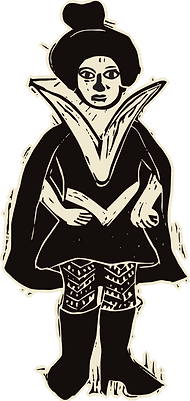
Autotrato is understood as the individual-symptom of a whole that begins with the Other. She exists because she always has references that place and recreate her within the collective. She is the subject who operates signifiers and makes relations, as associations, to open a breach from the known and its forms toward something we can all remember, know, recognize.
Her reflections center on being and on being a woman. In her experience as a gendered person, she looks to one side, looks to the other, looks at herself and confirms diversity. A diversity that forks from a symbolic plane, from an imaginary, a language, a properly feminine genealogy, toward inner worlds marked by the experience of lunar and hormonal rhythms and intimate customs.
Settled in otherness as a subject of knowledge and a social agent, but also as an object still wounded by violence and discrimination, she raises the need to constantly review the assumptions on which culture rests. It is precisely from this vulnerability that her transformative power emerges, turning the wound into an engine of change.

CUCA LA TORERA: STREET MILITANCY
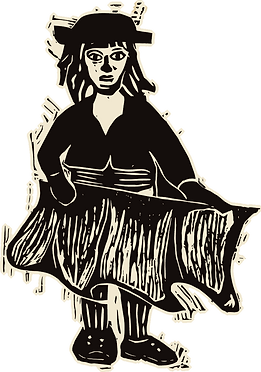
La Torera emerges from the urban echo to become street militancy of open disobedience. Her body becomes an instrument for penetrating public space, assaulting the weave of the city without warning, in the form of metaphor, game or complaint.
Her presence of mind transforms the environment: she turns the beginning and the after into chaos, which is the starting point of all possible and imaginary worlds. Taking up the carnivalesque initiatory liturgy of death and resurrection, inseparable and indispensable extremes, La Torera practices the liberation of desire.
She clings to the rupture of the barriers of the Self in affirmation of a strict monomania; she intervenes in space with the will to cross limits, using her own body as a tool. She dances, jumps, exceeds the speed of her game, turning each gesture into an act of resistance that redefines the codes of city space.
CUCA VIGOREXIA: THE NERVOUS VOICE OF AN INNER FORCE
Vigorexia is the nervous voice that emerges from the space of emptiness, of anxiety and cold, where a new sense of existence is found. She is the inner force that survives the experience of violence, which reverses the disorder to raise a voice that denounces and points straight at fear.
She unmasks the hypocrisy of the instrumental Judeo-Christian morality that acts against the social pacts yet disguises itself as good manners, silencing conscience with bribes to heaven. She rebels against the norms that limit thought and female being by regulating private and public bodily practices to sustain the regime of male domination.
She manifests in a journey through two incarnations: the force that reverses the insult and the survival of misogynist violence. These identities coexist in a world of imaginary construction that becomes reality. Each seeks the other in an inner dialogue that turns fear into indignation and indignation into action. Her body is the answer: a territory where plurality converges, without reproducing violence, hegemony or patriarchal moral prescriptions.

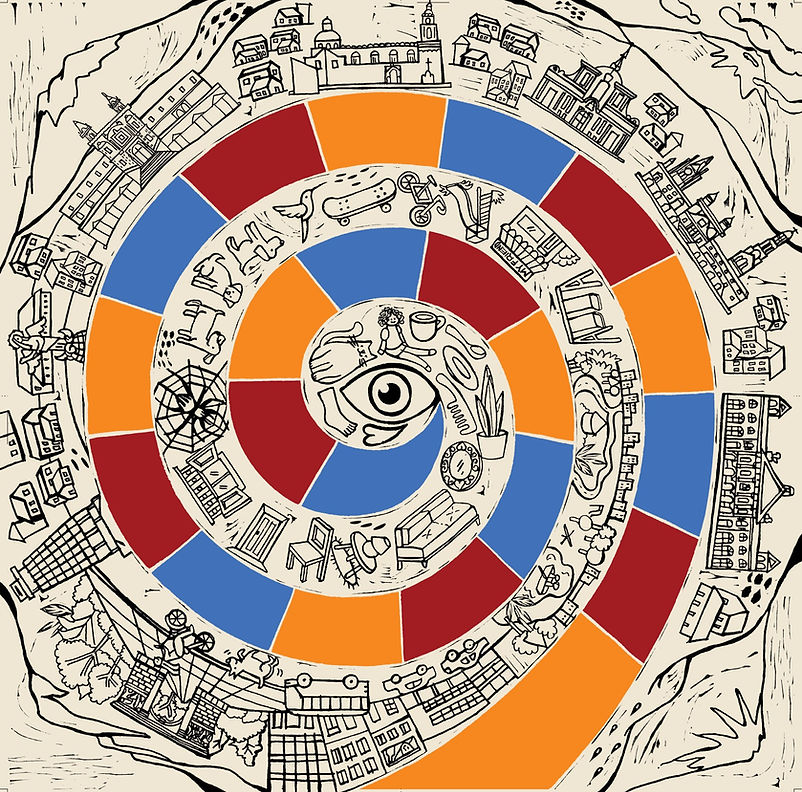
THREE SPACES OF PLAY
I open my hand and it extends into space. I look further in and the hand has its own space. I stretch out my arm and the little hairs cross the air, their tips bringing me new information. I exist in a place, but also in the mind. In this experience, everything is a conversation: space shapes bodily experience through its physical and symbolic structures, while the body acts on space through practices that inscribe meanings and turn the abstract into lived place.
The intimate is the sacred extension of the body, a territory where everyday rituals of self-care, reproduction and the sustaining of life unfold. It holds the founding question: who am I? It is a crossing that interweaves emotions, narratives and energetic networks, turning self-care into a silent revolution where the personal becomes cosmos.
The space of bonds is the living fabric of correspondences where care for the other and the common good are cultivated through rituals of reciprocity. This ecosystem disarms hierarchies by prioritizing shared feeling. Here care interweaves individual finitudes into communal continuity, recognizing interdependence as radical politics: to correspond is not to exchange, but to hold together the same thread of life.
The public space is street militancy: the collective body in revolt. In this territory, actions become strategy to challenge the prejudices of the context. The body interrupts norms with symbolic gestures that defy the hierarchies of what can be said, turning squares and streets into living canvases of a political action that reimagines the world.


CROWDFUNDING
Paulina Andrade Proaño
Martina Cobas and the Steffen Family
Francisco Andrade
Dayana Rivera
Mónica Vorbeck De la Torre
Fernando Andrade
Vinicio Pastor
Isabel Llaguno Albán and Jaime Sánchez
Marta Lucía Moreno Rojas
Santiago Reyes
Rocío Araujo
Patricia Granda
Cristina Duque
Monserrath Ruilova
Alejandra Núñez
Juan José Herrando Campillos
María Alejandra Auza Garrido
Isabel Benz Vega
Camila Enríquez